

Learning. Development. Creativity.

What makes Cambridge different?
Cambridge Preschool Philippines uses a hands-on, project-based curriculum to build thinking, creativity and life skills in children aged 10 months to 6 years.
Learning by doing:
iSTEAM + PBEM

No one can say for certain which jobs today's children will hold. What we can do is nurture the qualities machines cannot replicate: creativity, judgement, empathy and curiosity.

At Cambridge Preschool, children explore Innovation, Science, Technology, Engineering, Arts and Mathematics (iSTEAM) through our Project-Based Ecological Model (PBEM). Lessons are hands-on and built around real-world problems.

Here, children build, test and try again. We give curiosity room to grow, and understanding comes from doing, not memorising. Your child will learn to enjoy learning, think critically, ask questions, meet challenges with curiosity, and build life skills that carry well beyond primary school.
the cambridge routine
A typical day at Cambridge bridges structured learning, play and practical life skills. Each part of the routine builds a different skill, from early literacy to independence.

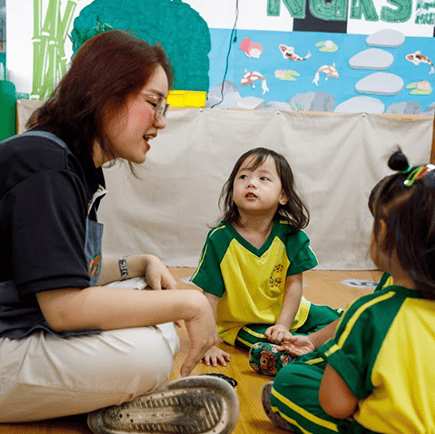
Circle Time (15 minutes)
We start the day together with greetings, songs and nursery rhymes. Singing, dancing and taking turns to speak build the language and social skills children need to communicate with confidence.

Small Group Learning (30 to 45 minutes)
In small groups, children work on early maths, reading, language and writing. Fine motor and practical life activities run alongside, so skills like holding a pencil and pouring a drink develop together.

Snack Time (10 to 20 minutes)
Children set their own tables, serve food and drinks, eat on their own and tidy up afterwards. Small daily responsibilities build self-reliance.

PBEM + iSTEAM (30 to 45 minutes)
Each term focuses on one topic, which children explore through discussion, experiments and fieldwork. This year’s topics are Light Forms, Sound and Music, Electronic Circuits and Basic Structures.

Self-Care Time (10 to 15 minutes)
Children practise brushing their teeth, folding clothes and packing their belongings, habits that prepare them for primary school.
Story Time and Dismissal (10 to 20 minutes)
The day ends with children reading both independently and as a group. Reading aloud strengthens vocabulary, confidence and speaking skills.
The Cambridge experience
Founded in Singapore in 1993 by Yale Holdings Pte Ltd, Cambridge has operated in the Philippines since 2001 through Cambridge Children’s Learning and Development Inc. (CCLDI). Across our centres, children aged 10 months to 6 years learn through a hands-on, project-based curriculum that builds thinking, creativity and life skills.

The Singapore standard of learning

Our curriculum follows the Cambridge Singapore framework, adapted for children in the Philippines. Lessons draw on local context and culture, from the fieldwork sites our classes visit to the stories and songs children already know, so learning feels familiar and stays relevant to each child.
CAMBRIDGE METHODOLOGIES
Our approach draws on six educators and approaches whose ideas continue to shape how the world understands children. Here is what each believed, and how it shows up in our classrooms.
Maria Montessori: following the child's interests
Montessori described a teacher’s greatest success as being able to say, “The children are now working as if I did not exist.” At Cambridge Preschool we share that goal. Classrooms are child-centred, with materials that support children’s interests and room to keep working on projects they care about. This is why our Project-Based Ecological Model (PBEM) lets each child pursue their own interests within the term’s topic.
Jean Piaget: constructing understanding
Piaget believed children construct their own knowledge by making sense of the people, places and things around them. Children learn best when they do the work themselves. In practice, this means we let children wrestle with a problem before we step in.
Lev Vygotsky: learning through play
Vygotsky believed that social and cognitive development work in tandem. When children play together, they use language, negotiate roles and even correct one another. Our curriculum is purposeful and play-based, and it emerges from the children’s own interests and experiences.
Urie Bronfenbrenner: nurturing the child's environment
Bronfenbrenner believed that a child’s immediate surroundings and relationships shape their development most. At Cambridge Preschool we build warm, trusting relationships between children, families and educators, so that home and school pull in the same direction, and we bring community visitors and local culture into the classroom to enrich learning.
Loris Malaguzzi and Reggio Emilia: seeing children as capable
The Reggio Emilia approach, developed by Loris Malaguzzi, starts from the belief that children are capable and can express themselves in many languages beyond the verbal. At Cambridge Preschool we invite children to learn through interaction, movement and observation, and to express themselves through music, art and play.
John Dewey: learning through experience
Dewey believed children learn best through experience in social, collaborative settings. Our students work together, share experiences and negotiate ideas as active explorers, learning social interaction and engagement along the way.
The best of each approach
We combine traditional teaching with project-based learning and ideas from the Montessori and Reggio Emilia approaches. With the right balance of guidance and freedom, every child can become the best version of themselves.
Traditional approach
Teachers lead structured lessons that introduce new concepts, build early literacy and numeracy, and show children how a classroom works.
Project-based learning
Over an extended period, children investigate a topic, test ideas and solve real-world problems through hands-on exploration. They learn to plan, collaborate, negotiate and see an idea through to the end.
Montessori method
Children choose their own activities and work independently, while learning to play collaboratively. This builds confidence, communication skills and a sense of ownership over their learning.
Reggio Emilia approach
Children express what they know in many ways: drawing, building, music, movement and drama. Teachers document and display that work so children see their ideas taken seriously.
Key Values

each child has a
unique potential

learning is a life-long journey

emotional awareness
See a Cambridge day for yourself
The best way to understand a Cambridge day is to spend one with us. Every child starts with a free 3-day trial.