
ISTEAM
&PBEM


well-rounded curriculum
Cambridge Preschool Philippines offers Pre-Toddler, Toddler, Junior Nursery, Senior Nursery and Kinder programmes for children aged 10 months to 6 years, built on the Singapore iSTEAM curriculum and our Project-Based Ecological Model (PBEM).
Cambridge brings the Singapore approach to early childhood education to the Philippines, as part of a network with centres in Singapore, China and Indonesia. Our well-rounded curriculum goes beyond academics, nurturing life skills, social intelligence and a love of learning.
Student-centred, teacher-led.
ISTEAM
Innovation, Science, Technology, Engineering, Arts and Mathematics
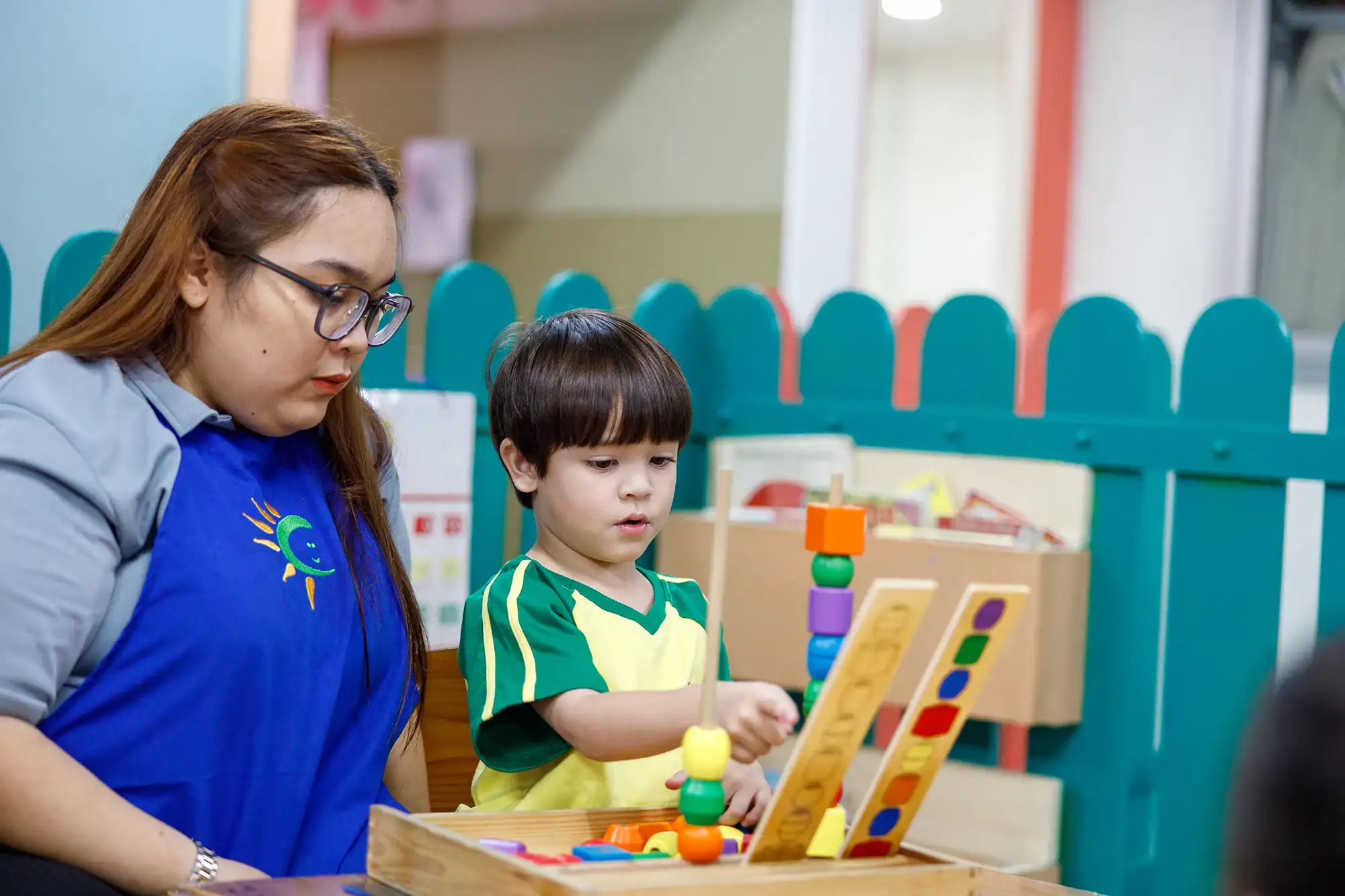
iSTEAM stands for Innovation, Science, Technology, Engineering, Arts and Mathematics. It follows a “thinking with hands” philosophy: children learn through hands-on inquiry and open-ended exploration of topics that interest them.
PBEM
Project Based Ecological Model
PBEM is how iSTEAM reaches the classroom. Each term the whole centre works on one topic. Children discuss it, research it, run experiments and go on fieldwork, then create projects from what they found. Primary school teachers tell us that children who learn this way arrive with better attitudes to learning and stronger problem-solving.
Programmes by level
| Level | Age | Schedule | Teacher to students |
|---|---|---|---|
| Pre-Toddler | 10 months to 1 year 5 months | 1-hour classes twice a week, with a parent or guardian in the room; contact your centre for the schedule | Small group with guardians |
| Toddler | 1 year 6 months to 2 years 5 months | 2 hours a day, 3 or 5 days a week | 1 : 6 |
| Junior Nursery | 2 years 6 months to 3 years 11 months | 3 hours a day, 5 days a week | 1 : 10 |
| Senior Nursery | 4 years to 4 years 11 months | 3 hours a day, 5 days a week | 1 : 12 |
| Kinder | 5 years to 5 years 11 months | 3 hours a day, 5 days a week | 1 : 15 |
The Full Day Programme adds lunch, an afternoon nap and an enrichment session to the morning Cambridge Routine. Selected centres also offer Reading Lab, Arts and Crafts, Cooking, Science Club, Movement and Fitness, and Mandarin. Ask your centre which are available.
Term topics for SY 2026-27
Every level from Toddler to Kinder explores the same four topics, pitched to their age.
| Term | Topic | What children explore |
|---|---|---|
| Term 1 | Light Forms | The shapes and patterns light makes when it meets an object: shadows, reflections and colours |
| Term 2 | Sound and Music | Sounds made by singing, humming, instruments and rhythmic movement, and how volume and tempo change them |
| Term 3 | Electronic Circuits | How electricity travels in a complete path from a power source to a bulb or motor |
| Term 4 | Basic Structures | The framework that holds something together so it stays strong, stable and standing |
How to enrol
- Book a free 3-day trial by completing the Inquiry Form. The Directress of your chosen centre will contact you to confirm the dates. Slots are first-confirmed, first-served.
- Join the trial. After the three days, the teacher shares what she observed and how Cambridge can support your child’s learning.
- Receive the enrolment pack from the Directress: the enrolment form and tuition fee agreement, fetcher’s ID card, bank details, amount to pay and the Parent Handbook.
- Return the completed forms with your child’s birth certificate, immunisation records, proof of payment and the signed Parent Handbook receiving copy.
- Once payment is verified, you receive an Official Receipt and your child’s place is confirmed.
Health and safety
Every centre uses UV sanitation, HEPA filters in each air-conditioning unit, a non-contact thermal scanner at the entrance and a hand-washing station by the door, so children wash up as they arrive.

Our purpose is to equip each child with the necessary tools and future-proof skills that involves:

environment
Our purpose is to scaffold each child through our comprehensive child care programme that involves:

TEACHERS
Warm, caring, nurturing and qualified teachers and caregivers with positive attitudes of trust, respect and understanding of children.

programmes
Developmentally appropriate preschool programmes with concrete, interactive, learning experiences that take into account each child’s individual needs, interests, abilities and culture.